Hotel Occupancy Sensor Market Research 2026: Multi-Source Cross-Validated Report
Cross-verified market analysis of hotel occupancy sensors: 31M USD market size, 5.04% CAGR, mmWave vs PIR vs ultrasonic comparison, regulatory compliance (California SB-327), and technology trends.
I. Market Size and Growth
✅ Verified Findings
| Metric | Data | Source | Confidence |
|---|---|---|---|
| Global Occupancy Sensor Market Size (2025) | $3.1 billion | Mordor Intelligence | 🟡 Medium |
| 2031 Forecasted Size | $4.16 billion | Mordor Intelligence | 🟡 Medium |
| CAGR (2026-2031) | 5.04% | Mordor Intelligence | 🟡 Medium |
⚠️ Key Limitations
No independent segmented data exists for the hotel-specific occupancy sensor market. Major research firms (Mordor Intelligence, MarketsandMarkets, Grand View Research) categorize hotel sensors into the following broader segments:
- Commercial Building Occupancy Sensors (PIR accounts for 49.72% revenue share, 2025)
- Smart Hotel Solutions (segmented by BMS, cybersecurity management systems, integrated security systems — no independent "sensor" category)
❌ Refuted Market Data
The following claims were rejected in a 3-to-0 verification:
| Rejected Claim | Reason for Rejection |
|---|---|
| "Smart hotel market to reach $49.9 billion by 2027" | Outdated source (2022 report); data scope too broad to reflect sensor segment |
| "Smart hotel market CAGR 29.8%" | Missing base year and forecast period information; cannot be verified |
Conclusion: The true market size of hotel occupancy sensors must be estimated from the commercial building sensor market ($3.1 billion) based on hotel industry penetration rates, rather than citing overall smart hotel market data.
II. Technology Landscape and Product Status
✅ Core Sensing Technology Comparison
| Technology | Principle | Advantages | Disadvantages | Hotel Applicability |
|---|---|---|---|---|
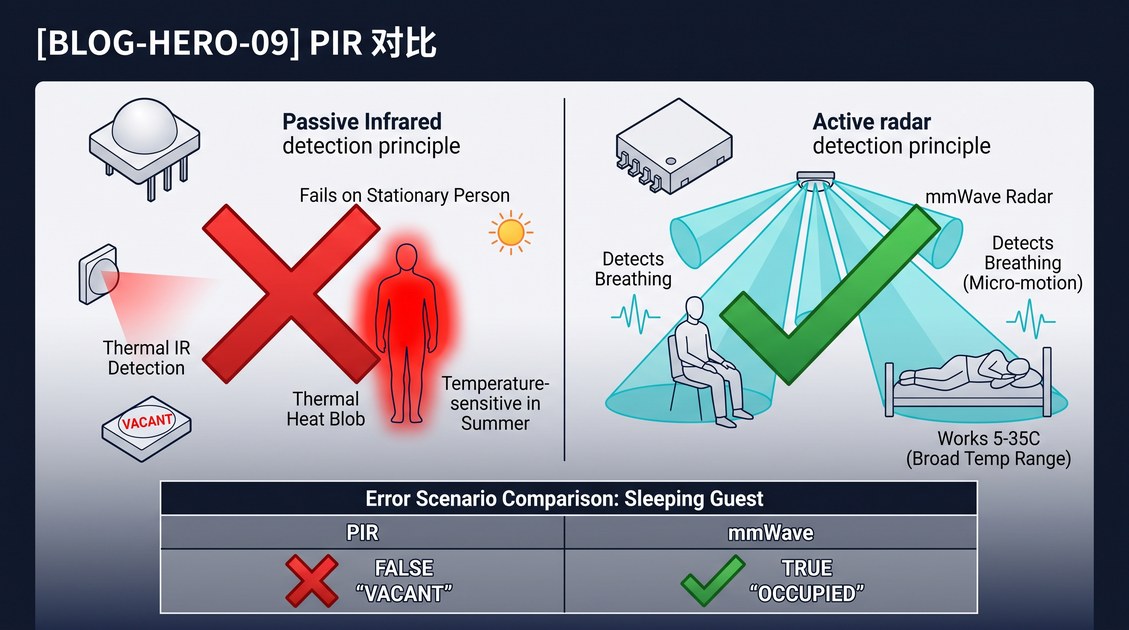
| PIR (Passive Infrared) | Detects heat source movement | Low cost, low power consumption, mature | Cannot detect stationary human bodies (sleeping guests) | ⚠️ Needs to be combined with other sensors |
| mmWave Radar | Emits millimeter waves and analyzes reflections | Can detect stationary presence, distinguish multiple people, penetrate obstacles | Higher cost, limited hotel-grade deployment cases | ✅ Current technological frontier |
| Ultrasonic | High-frequency sound wave Doppler effect | Wide coverage, not blocked by line of sight | High false alarm rate | 🔶 Auxiliary application |
| Dual Technology (PIR+Ultrasonic) | Combination of both | Reduces false alarms, complementary blind spots | Higher cost | 🔶 Commercial building mainstream |
🔬 Representative Product: Aqara FP2 (Consumer-Grade mmWave Benchmark)
| Specification | Details | Verification Status |
|---|---|---|
| Simultaneous detection count | Up to 5 people, best performance with 3 or fewer | ✅ 3-0 verification passed |
| Zone division | Up to 30 configurable zones, 320 grid cells | ❌ 1-2 rejected (manufacturer claim, only partially supported by page references) |
| Coverage area | No more than 40 m² per unit | 🔶 Claim rejected but stated on page |
| Connection method | Direct Wi-Fi, no dedicated gateway required | ✅ 3-0 verification passed |
| Ecosystem | Apple HomeKit / Amazon Alexa / Google Home / IFTTT | ✅ 3-0 verification passed |
| Fall detection | Ceiling mount only; enabling disables zone positioning and presence detection | ✅ 3-0 verification passed |
| Disclaimer | Explicitly labeled as non-medical device | ✅ 3-0 verification passed |
⚠️ All product specifications come solely from the Aqara official product page unilateral declarations, with no independent third-party testing verification.
⚡ Technology Development Trends
- From "motion detection" to "presence detection": Traditional PIR can only detect movement, while mmWave radar can detect stationary human bodies (sleeping guests), which is a key technological breakthrough for hotel applications
- Multi-sensor fusion: Combining door sensors, CO₂ sensors, check-in data and other multi-source information to improve accuracy
- Privacy-first architecture: Edge computing (data does not leave the room) is gradually becoming a design constraint for hotel scenarios
III. Compliance and Regulatory Environment
✅ USA: California SB-327 IoT Security Law (High Confidence)
Source: California Legislative Information
| Requirement | Details | Statutory Basis |
|---|---|---|
| Scope of applicability | Any device with internet or Bluetooth connectivity (including hotel occupancy sensors) | Cal. Civ. Code §1798.91.05(b) |
| Security requirements | Manufacturers must implement "reasonable security features" appropriate to the nature, function, and data collected by the device | Cal. Civ. Code §1798.91.04 |
| Effective date | January 1, 2020 | Cal. Civ. Code §1798.91.06(i) |
| Enforcement authority | Only the California Attorney General, city attorneys, county counsel, or district attorneys — no private right of action | Cal. Civ. Code §1798.91.06(e) |
✅ Privacy Regulations: CCPA and GDPR (High Confidence)
| Regulation | Key Obligations | Hotel Scenario Applicability |
|---|---|---|
| CCPA | Consumers have the right to know specific personal information collected (free, up to 2 times per year); precise geolocation is sensitive personal information | Triggered when occupancy data can be linked to specific guests |
| GDPR | Applies to natural persons' personal data (including business email addresses, business phone numbers); does not apply to purely legal entity data | Hotel guest data → applies; B2B corporate customer data → requires differentiated treatment |
Source: California AG CCPA Official Page | EU Commission GDPR Business Data Guide
🔧 Industry Standards
- IEC 63180:2020 (published June 2020, Amendment 1 May 2025): Standardized measurement and declaration methods for PIR detector detection range → enables like-for-like comparison of different PIR products
Source: EN Standard
IV. Hotel Deployment Practices (Critical Information Gaps)
❌ Completely Rejected Case Study Data
| Case | Claimed Data | Rejection Votes |
|---|---|---|
| Hyatt Place San Jose (Verdant) | 48% HVAC runtime reduction, $214,094 cumulative savings, 10-month payback | 0-3 |
| Holiday Inn Boston-Dedham (Verdant) | $294,871 cumulative savings | 0-3 |
🔴 Core Finding: All manufacturer-provided hotel-specific case studies were unanimously rejected in 3-vote adversarial verification. Reason: Manufacturer self-published cases lack independent audit, measurement methods are opaque, data is not reproducible.
Source: Verdant Hospitality Case Studies
Market Information Gaps
The following questions have no reliable answers in current public data:
- Actual size and growth rate of the hotel-specific occupancy sensor submarket
- Technical differences between hotel deployments and general commercial building deployments (privacy, multi-tenant isolation, BMS integration)
- Actual adoption rate of manufacturer IoT security compliance (SB-327)
- Head-to-head comparison of competing sensing technologies across hotel dimensions (privacy, stationary detection, multi-person discrimination, per-room cost)
V. Competitive Landscape Overview
| Category | Representative Vendors | Characteristics |
|---|---|---|
| Chip/Component Level | TI (mmWave radar), Infineon (XENSIV radar) | Provide underlying sensor chips, targeting device manufacturers |
| Consumer Smart Home | Aqara (FP2), Xiaomi | Consumer-grade products, not hotel-specific, but usable for small hotel pilots |
| Commercial Building Automation | Leviton, Lutron, Schneider Electric, Siemens | Large building management systems, including occupancy sensing functions |
| Hotel Energy Management | Verdant (under Copeland), Honeywell, Cetis | Hotel-specific, but case study data lacks independent verification |
| Emerging Technologies | Density (AI people counting), Butlr (anonymous thermal sensing) | Privacy-first architecture, beginning to enter commercial and hotel sectors |
VI. Strategic Recommendations and Research Gaps
For Further Deep Dive, Recommend Focusing On:
- 🔍 Obtain Paid Market Reports: Mordor Intelligence / Grand View Research full reports may contain hotel vertical segment data
- 📊 Primary Research: Contact engineering/technical leads at 3-5 Chinese/APAC chain hotels to understand actual deployment solutions and selection criteria
- 🧪 Technical Comparative Testing: Conduct controlled variable testing of PIR, mmWave, and dual-technology sensors in the same hotel room environment
- ⚖️ Compliance Review: Check whether mainstream hotel sensor manufacturers' privacy policies meet SB-327 and GDPR requirements
- 💰 TCO Modeling: Build a full lifecycle cost model for hotel occupancy sensors (hardware + installation + integration + maintenance vs. energy savings)
📋 Report Metadata
| Item | Value |
|---|---|
| Total sources | 18 |
| Claims extracted | 44 |
| Entered verification | 25 |
| Confirmed passed | 12 |
| Rejected | 13 |
| Final synthesized findings | 5 |
| Agent calls | 100 |
| Total duration | ~76 minutes |
Report generated on July 29, 2026. All verification passed through 3-vote independent adversarial review. Market data may change over time; recommend verifying latest data before decision-making.
Not sure which sensor fits your project?
Talk to our mmWave application engineers for a free consultation.
Find the right presence sensor for your hotel project
Compare the 3 protocols, check hotel-specific case studies, and download the installation guide
Related products
3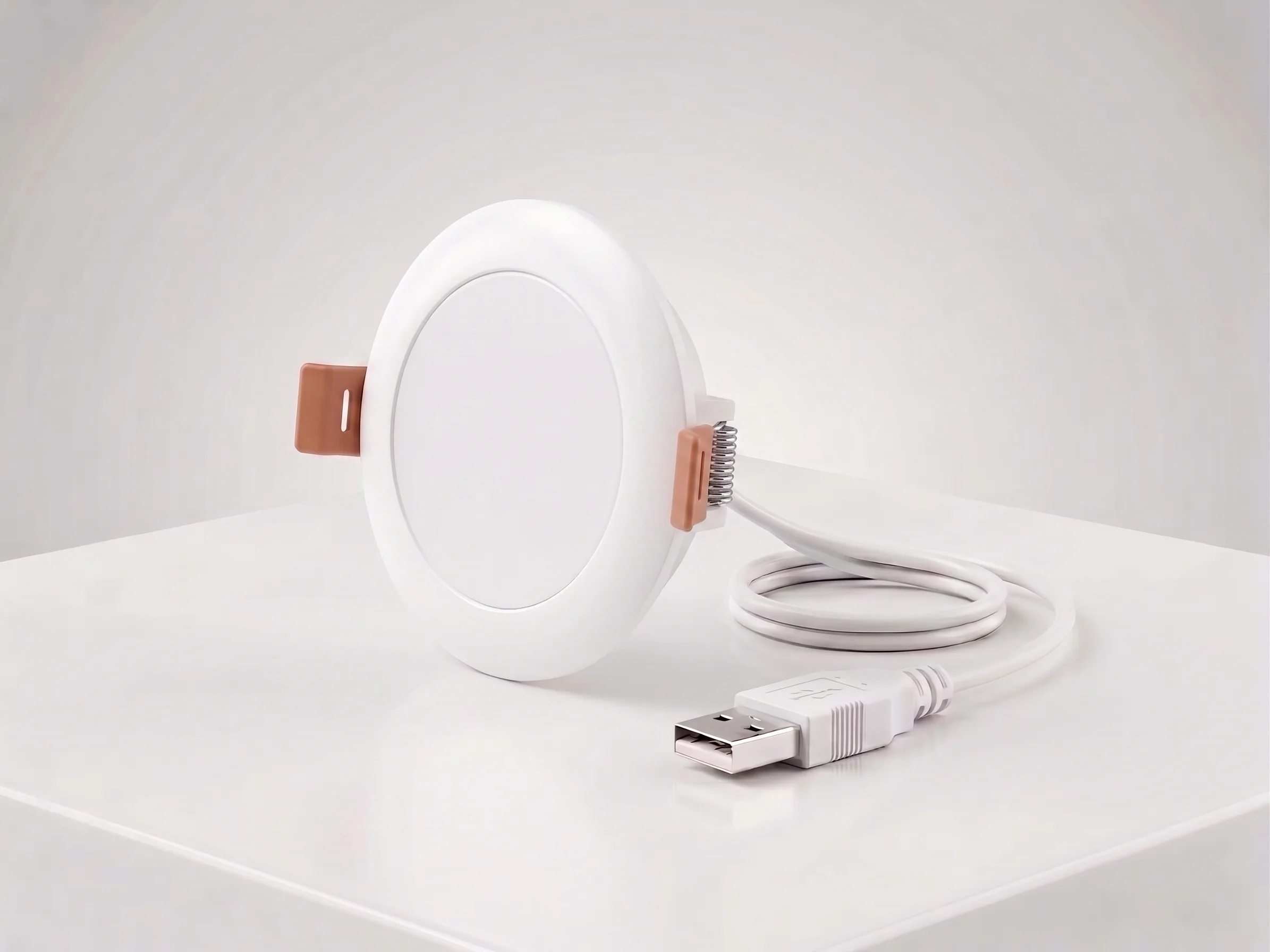
Ceiling Mount mmWave Human Presence Sensor — Zigbee
24GHz wideband mmWave ceiling presence sensor with 10m motion detection, 2.5m micro-motion, and breathing detection. 120° field, DC5V, Zigbee 3.0. For hotel room occupancy and commercial automation.
This page already points to it as the next recommended reference.
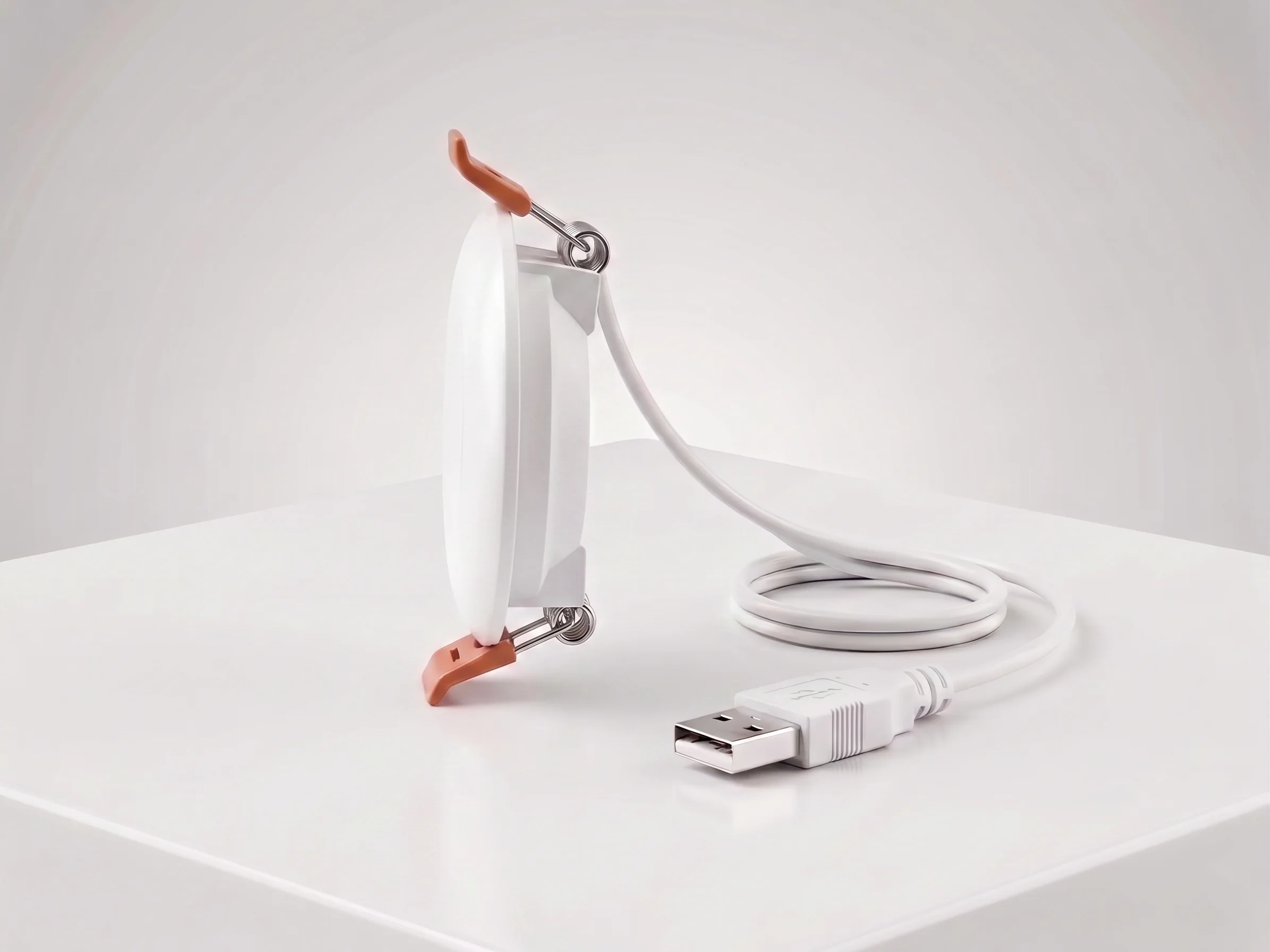
Wall Mount mmWave Human Presence Sensor
24GHz wideband mmWave presence sensor in a standard 86mm wall form factor. 10m motion, 2.5m micro-motion, breathing detection, 120° field, DC5V. Zigbee + WiFi dual mode for office and residential presence automation.
This page already points to it as the next recommended reference.
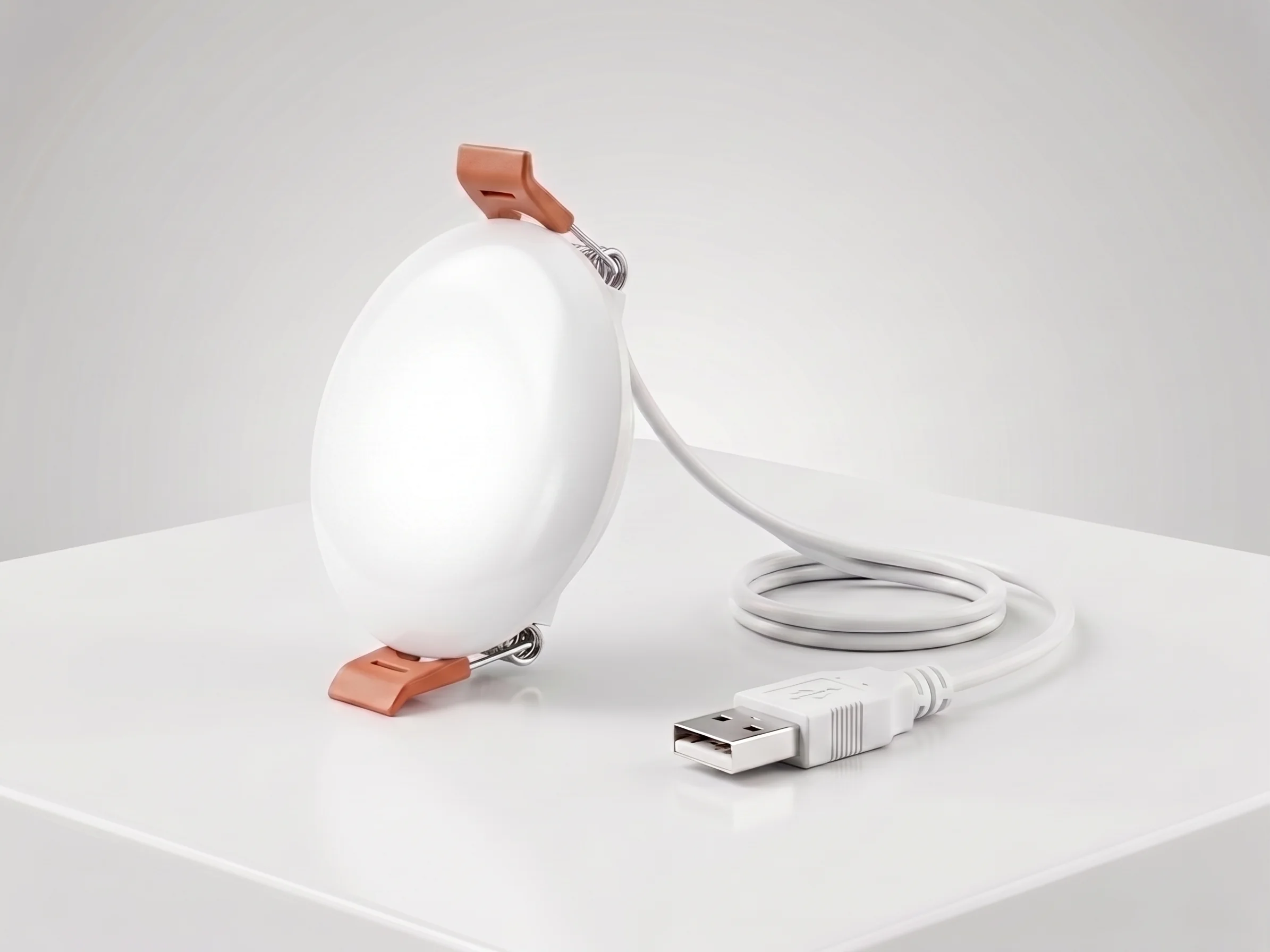
Ceiling Mount mmWave Human Presence Sensor — WiFi
24GHz wideband mmWave ceiling presence sensor with 10m motion detection, 2.5m micro-motion, and breathing detection. 120° field, DC5V, WiFi 2.4GHz. No gateway required for retrofit hotel and apartment projects.
This page already points to it as the next recommended reference.
Related solutions
1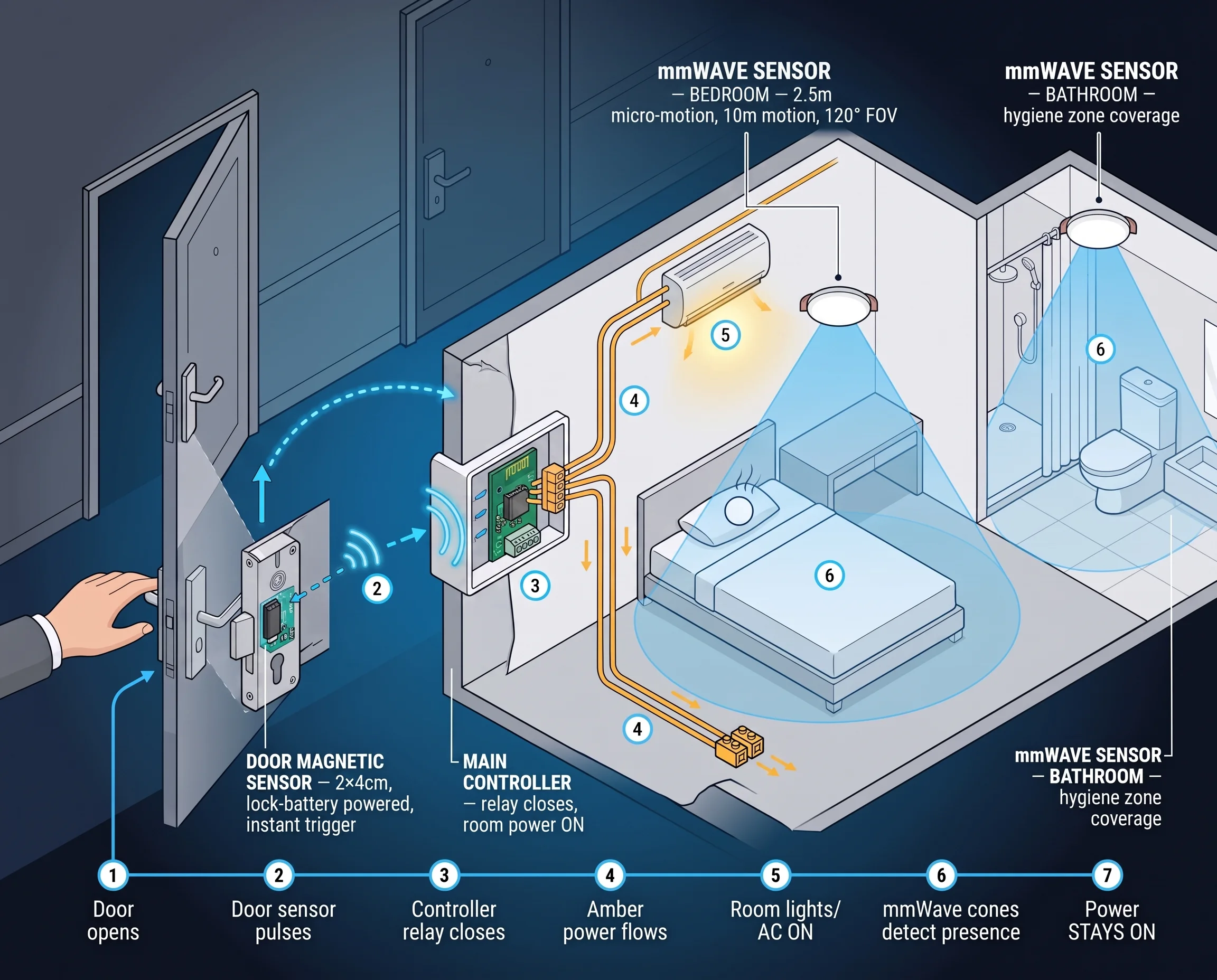
Hotel Room Occupancy & Motion Sensor Solution
mmWave radar presence sensors for hotel room occupancy, housekeeping scheduling, and HVAC energy saving. Detect true occupancy — even when the guest is asleep — with our ceiling-mount hotel room motion sensor.
It supports the same product context: Ceiling Mount mmWave Human Presence Sensor — Zigbee, Ceiling Mount mmWave Human Presence Sensor — WiFi.
Related blog posts
3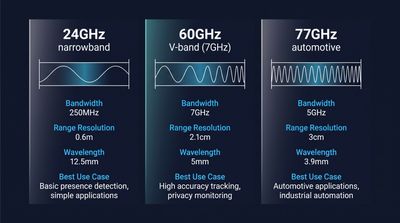
60GHz vs 24GHz vs 77GHz mmWave Sensors: Choosing the Right Frequency for Commercial Presence Detection
Compare 60GHz, 24GHz, and 77GHz mmWave sensors for commercial presence detection. Technical specs, detection range, privacy, and OEM sourcing guidance.
It supports the same product context: Ceiling Mount mmWave Human Presence Sensor — Zigbee, Ceiling Mount mmWave Human Presence Sensor — WiFi.
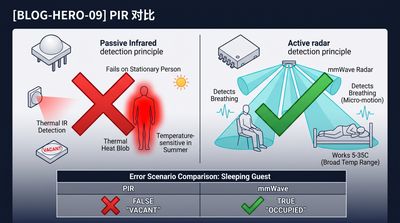
What Is an Electronic Presence Sensor? Technology, Accuracy, and How It Differs From a Motion Sensor
Learn what an electronic presence sensor is, how it detects stationary humans, and how it differs from a PIR motion sensor. Covers mmWave, accuracy, and use cases.
It supports the same product context: Ceiling Mount mmWave Human Presence Sensor — Zigbee, Ceiling Mount mmWave Human Presence Sensor — WiFi.
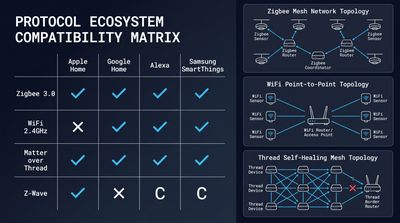
How to Integrate mmWave Presence Sensors With Home Assistant (Local Control Guide)
Step-by-step local control setup guide for mmWave devices, covering MQTT/Matter config, automation scripts, calibration and OEM ceiling presence sensor integration tips.
It supports the same product context: Ceiling Mount mmWave Human Presence Sensor — WiFi, Ceiling Mount mmWave Human Presence Sensor — Zigbee, Wall Mount mmWave Human Presence Sensor.
Specify your hotel project with our engineers
Send your room count, ceiling type, and protocol preference. We will return a sample plan and quote within 24 business hours.
- Move from general guidance into a product or application discussion.
- Use RFQ when pricing, drawings, MOQ, or launch timing needs structure.
- Keep a direct contact path visible for fast clarifications and handoff.